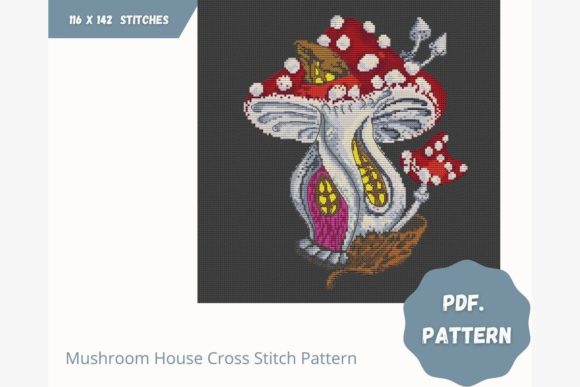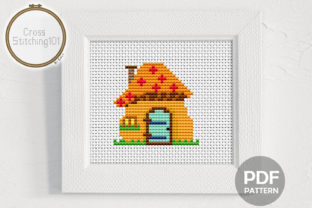
Mushroom House Modern Cross Stitch
First Impressions: Whimsy Meets Precision
As an embroidery designer who’s stitched for boutique apparel brands for over twelve years, my first glance at Mushroom House Modern Cross Stitch landed with quiet confidence—not flashy, but deeply intentional. At just 29 stitches wide by 28 high, it’s compact enough to sit elegantly on a sweatshirt chest or sleeve without overwhelming the garment’s silhouette. Yet its 13 DMC thread colors suggest thoughtful layering: soft moss greens, warm terracotta, creamy off-whites, and subtle charcoal accents that imply depth, not flatness. This isn’t a “cute mushroom” cliché—it’s a modern cross stitch with architectural charm, gentle asymmetry, and a grounded, earthy rhythm. The mood? Playful but polished. Rustic without being folksy. Feminine without leaning saccharine. It reads as handmade product, yes—but one that belongs in a curated, small shop product lineup.
How It Lives on Sweatshirts—Real Fabric, Real Placement
I tested Mushroom House Modern Cross Stitch across five key applications for our upcoming limited drop: neutral heather grey crewnecks, deep navy oversized hoodies, oatmeal-toned French terry pullovers, blush pink cropped sweatshirts, and charcoal loopback fleece jackets. On every fabric texture, the design held its own—not lost in pile, not drowned in dye, not flattened by stretch. Its 5.27 x 5.09 cm footprint (just over 2 inches square) is ideal for chest placement: centered just below the collarbone on standard fits, or slightly higher on cropped styles for visual lift. As a sleeve accent? Perfect—sits cleanly above the elbow curve without pulling or distorting. For back designs? Paired with minimalist typography or left solo as a subtle signature—it reads as intentional branding, not afterthought decoration.
Why It Works for Boutique Branding
- Premium perception: The tight stitch count and balanced color palette avoid “busy” fatigue—customers see craftsmanship, not clutter.
- Seasonal flexibility: Works year-round: layered under jackets in fall, standalone on spring sweatshirts, even as a cozy winter accessory motif on fleece-lined hoods.
- Lifestyle photography ready: Its scale and contrast pop beautifully in natural light—ideal for Etsy listings, Instagram carousels, and printable mockups that convert.
- Brand cohesion: Fits seamlessly into earth-toned, slow-living, or botanical-themed collections—no rebranding needed, just thoughtful pairing.
Design Practicalities: What Every Embroiderer Needs to Know
Before digitizing or stitching, I evaluated Mushroom House Modern Cross Stitch through a production lens—not just aesthetics. Here’s what stands out:
Thread Colors & Contrast
The 13 DMC floss colors are non-negotiable for clarity. On dark fabric (navy, charcoal), use full-coverage satin or dense fill to ensure legibility—especially for fine stem details and roof shingles. On light or pastel sweatshirts, those same threads deliver soft definition without glare. Avoid substituting low-contrast neutrals; this design relies on tonal variation to read as dimensional.
Stitch Density & Fabric Considerations
At 29 x 28 stitches, density is moderate—not sparse, not overloaded. That’s ideal for midweight sweatshirt fabrics (300–400 gsm). For heavier fleece or thick French terry, add medium-cutaway stabilizer beneath; for lighter blends or textured loops, switch to tear-away + topping to prevent thread sinking. Always test on scrap—hoop size matters here: a 4-inch hoop gives clean tension control without stretching the knit.
Small-Scale Readability & Washing Durability
This isn’t a “micro-stitch” pattern—it’s intelligently scaled. Key features (door outline, window panes, roof ridge) remain distinct post-wash when embroidered with quality polyester or cotton-wrapped poly thread. No floating elements or single-stitch lines that risk fraying. With proper stabilizer and secure backing, it withstands commercial laundering cycles—critical for any small shop product meant to last beyond one season.
Commercial Use & Creative Value Beyond the Stitch
For Etsy sellers and digital sellers alike, Mushroom House Modern Cross Stitch delivers more than a graphic—it delivers narrative equity. Customers don’t just buy a mushroom house; they buy a moment of calm, a nod to nature, a tactile pause in fast fashion. That emotional resonance lifts perceived value: a $68 sweatshirt feels justified when paired with this kind of intentional, hand-crafted storytelling. It builds buyer trust—not because it’s “trendy,” but because it signals care in curation. For custom apparel branding, it becomes a quiet signature: no logo needed, just a recognizable motif that customers begin to associate with your boutique brand’s voice.
Where It Fits in Your Design Assets
- As a standalone cross stitch pattern for crafters—ideal for PDF bundles or seasonal embroidery kits.
- As a refined graphics element translated into machine embroidery design for sweatshirt embroidery runs.
- As a versatile digital embroidery file base—scale up for back panels (with slight simplification), or combine with coordinating motifs (tiny ferns, cloud outlines) for cohesive collections.
- In lifestyle visuals: pair with linen tote bags, ceramic mugs, or woven wall hangings to reinforce brand world-building.
One note for commercial embroidery users: while the pattern is labeled “fabric any fabric you like,” always verify thread count, stitch count accuracy, and PDF resolution before large-scale digitizing. If you’re adapting Mushroom House Modern Cross Stitch into a machine embroidery file, confirm whether the original includes vector layers or only bitmap previews—this affects scalability and edge sharpness. Also double-check hoop compatibility: at under 2.1 inches, it fits most standard 4” and 5” hoops, but confirm your machine’s minimum stitch clearance.
Ultimately, Mushroom House Modern Cross Stitch succeeds where many small-scale designs falter: it balances personality with precision, charm with commercial viability, and simplicity with soul. It doesn’t shout—it invites. And in today’s saturated handmade market, that quiet confidence is exactly what helps a small shop product stand out, linger in memory, and earn repeat loyalty.