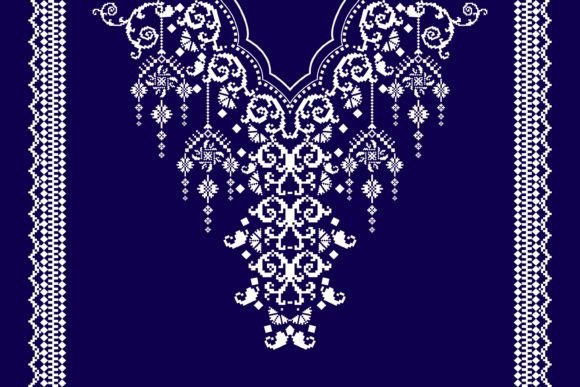
Beautiful Neckline Embroidery Pattern
First Impression: Bold, Cultured, and Instantly Recognizable
As an embroidery designer who’s curated over 200 craft fair booths—and sold thousands of handmade products—I opened Beautiful Neckline Embroidery Pattern expecting charm. What I got was presence. The title alone signals intention: “neckline” implies wearability and feminine detail; “beautiful” isn’t decorative fluff—it’s a promise of visual payoff. Combined with the description—knitted floral neckline embroidery, geometric ethnic oriental pattern, traditional background, blue and white tone, Aztec style, abstract—this isn’t just another floral motif. It’s a cultural fusion piece: structured yet organic, graphic yet handcrafted, minimalist in palette but maximalist in storytelling. At a glance, it reads as premium, intentional, and gallery-ready—exactly what draws slow shoppers at craft fairs and builds trust for Etsy sellers.
Where It Shines: Craft Fair Product Pairings That Sell
This design doesn’t need to be everywhere—it needs to be *right* somewhere. Here’s where Beautiful Neckline Embroidery Pattern earns its booth space:
- Tote bag design: Centered on the front panel or elegantly curved along the top hem, it transforms an everyday market bag into a statement piece. Blue-and-white reads crisp against natural canvas or indigo-dyed cotton.
- Apron embroidery: Perfect above the pocket or along the bib edge—its geometric rhythm balances the softness of linen or denim aprons without competing with functional details.
- Tea towel embroidery: Works exceptionally well as a top-border accent. The “knitted floral” suggestion gives subtle texture even in flat stitch, and the traditional background reads beautifully on tightly woven cotton or bamboo blends.
- Embroidered patch: Ideal for iron-on or sew-on application on denim jackets, market bags, or kids’ backpacks. Its balanced scale and clear negative space make it highly legible at 3–4 inches wide.
- Pillow cover & small pouch: Scales down gracefully—no loss of identity. The Aztec-style abstraction holds up even when stitched at 2.5" tall, making it versatile for giftable handmade products.
It’s notably less effective on curved cap surfaces or tiny keychains—its strength lies in deliberate placement, not forced miniaturization.
Real-World Production Notes Every Embroiderer Should Know
Before loading your machine, treat Beautiful Neckline Embroidery Pattern like a trusted collaborator—not just a digital embroidery file. Here’s what my test run revealed:
- Stitch density matters: The “geometric ethnic oriental pattern” and “knitted floral” elements suggest layered fills and fine line work. Check for dense satin columns or tight fill areas—these demand quality stabilizer (cutaway + tear-away combo recommended) and may require slower speed on textured towels or thick linen.
- Blue-and-white contrast is your friend—but verify thread colors: Not all “blue” threads read equally under fair lighting or on camera. Test on your actual fabric: navy on cream? Cobalt on oat? A single thread swap can lift or mute the entire design.
- Small details hold up—but only if hooped cleanly: Those abstract floral motifs rely on clean spacing. If your hoop shifts mid-stitch, delicate stems or geometric corners blur. Confirm hoop size compatibility before batch production.
- Avoid dark fabric unless you’re using bright white or metallic thread: The design’s elegance lives in tonal contrast. On charcoal or black fabric, it risks reading as “muted” rather than “sophisticated”—unless intentionally elevated with reflective thread.
Why This Pattern Builds Your Brand—Not Just Your Inventory
Beautiful Neckline Embroidery Pattern does more than decorate—it communicates. Its blend of Aztec geometry and knitted florals whispers “handmade with heritage awareness.” That resonates deeply with boutique makers and conscious consumers. On your craft fair table, it elevates adjacent items: a plain linen tea towel becomes collectible; a simple cotton tote feels curated. For Etsy sellers, it strengthens brand consistency across listings—especially when used alongside matching printable mockups or cohesive design assets. Buyers don’t just buy a stitched motif—they buy the feeling of wearing something timeless, culturally grounded, and quietly confident.
Designer-to-Designer Checklist Before You Cut Fabric
- Test the Beautiful Neckline Embroidery Pattern on scrap fabric that matches your final product’s weight and texture.
- Compare thread contrast under both natural light and fair-tent LED lighting.
- Review spacing between elements—tight gaps may close up on plush fabrics like terry cloth or fleece.
- Confirm commercial licensing status. As a Graphics and Patterns category file, this is likely intended for finished product resale—but always verify terms before selling embroidered goods.
- Create at least one real mockup (not just digital). Drape it on your tote or pin it to your apron sample. Does it draw the eye? Does it feel balanced? Does it photograph well?
- Compare how it reads across three fabric colors: light neutral, medium tone, and deep solid. Its versatility across palettes is part of its quiet power.
The Bottom Line for Creative Entrepreneurs
Beautiful Neckline Embroidery Pattern isn’t filler—it’s a focal point. It performs best when treated with intention: placed thoughtfully, stitched precisely, and presented alongside complementary handmade products. It sells because it feels both familiar and fresh—like a vintage textile rediscovered and reimagined. For craft fair sellers, it’s booth gold. For Etsy sellers, it’s listing magnetism. For embroidery business owners, it’s repeatable, licensable, and rich with storytelling potential. Just remember: great design demands great execution. Test. Refine. Repeat. Then watch customers pause, point, and ask, “Where did you get that?”