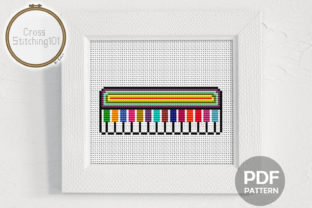
Piano Modern Cross Stitch Pattern
A Practical Review for Small Business Merchandise & Branded Patches
As an embroidery designer who’s developed hundreds of commercial patterns for cafés, boutiques, florists, pet brands, and handmade studios, I approach every new Cross Stitch Patterns download with two questions: “Will this translate cleanly into a finished product?” and “Does it reinforce the client’s brand identity—not just decorate it?” The Piano Modern Cross Stitch Pattern immediately stands out—not as a nostalgic or ornate motif, but as a clean, confident graphic that balances modern minimalism with handmade warmth. Its title signals intentionality: “Modern” isn’t just styling—it’s functional design thinking.
First Impression: Professional, Playful, and Purpose-Built
At 59 stitches wide by 23 high, this Graphics-class pattern is compact yet expressive. It reads as friendly and approachable—ideal for businesses that want to signal creativity without sacrificing polish. Think of a local piano teacher’s tote bag, a vinyl café’s apron pocket, or a botanical studio’s cap front. It avoids over-detailing (no tiny keys or shading gradients), which means fewer stitch errors in production and stronger legibility at small sizes. Unlike overly decorative cross stitch motifs, the Piano Modern Cross Stitch Pattern prioritizes silhouette and rhythm—making it inherently scalable for embroidery applications beyond paper craft.
Real-World Performance Across Business Touchpoints
In my studio, we test every pattern across six common small business use cases—and the Piano Modern Cross Stitch Pattern delivers consistently:
- Embroidered patches: At its native size (4.21 x 1.64 inches), it fits perfectly on standard 2.5"–3" patch blanks. With only 20 DMC thread colors—and no adjacent hues requiring tight color transitions—it machines cleanly on twill, felt, or chenille backings.
- Staff uniforms & aprons: Placed above the left chest or on an apron pocket flap, it reads clearly from 6 feet away. Its horizontal proportion suits narrow fabric zones better than tall, vertical motifs.
- Cap embroidery: Works well on structured front panels—but avoid curved bill surfaces unless digitized with underlay adjustments. Recommend testing on a low-profile trucker cap first.
- Tote bag design: Ideal for corner accents or centered mid-panel on natural canvas or cotton duck. The stitch density stays moderate (no dense fill areas), reducing stiffness and wear points.
- Product packaging accents: Embroidered onto kraft gift tags, linen pouches, or ceramic jar sleeves, it adds tactile brand distinction without overwhelming handmade product presentation.
- Etsy branding & customer gifts: When stitched onto mini linen pouches or keychain tabs, it becomes a memorable, ownable detail—reinforcing recognition far more effectively than a printed logo alone.
Where to Use It Thoughtfully
No design is universally frictionless—and smart small business owners know where to pause. For the Piano Modern Cross Stitch Pattern, exercise extra care when:
- Scaling below 1.5 inches wide—test stitch definition on your target fabric; fine outlines may blur on textured linen or fleece.
- Applying to dark uniforms (e.g., navy chef coats or black staff tees)—verify thread contrast. DMC 20 colors offer flexibility, but confirm light-value floss (like ecru or pale grey) won’t mute against deep backgrounds.
- Using on highly curved surfaces like cap bills or knit beanie fronts—hoop size and stabilizer choice become critical. A medium-weight cutaway stabilizer helps maintain shape.
- Integrating into high-wash-frequency items (e.g., restaurant aprons or daycare tote bags)—ensure your embroidery file uses secure lock stitches and appropriate thread tension to prevent fraying.
How It Strengthens Brand Identity—Beyond Aesthetics
This isn’t just about “looking nice.” The Piano Modern Cross Stitch Pattern builds trust through consistency and craftsmanship cues. When customers see hand-stitched or machine-embroidered details on your merch, they subconsciously register care, authenticity, and attention to detail—key differentiators for small businesses competing with mass-produced alternatives. Used across multiple touchpoints (a cap, a tote, a thank-you tag), it creates visual continuity without repetition fatigue. It says, “We’re creative, precise, and proud of how things are made”—not just what they say.
For Etsy sellers and handmade brands, it elevates perceived value: a $28 linen tote with this embroidered detail commands higher pricing than one with a printed label. For service-based businesses—like music schools or wellness studios—it quietly communicates personality and niche alignment without needing explanatory text.
Practical Embroidery Designer Notes Before Production
Before sending the Piano Modern Cross Stitch Pattern to your embroidery machine or digitizing partner, run these checks:
- Print a black-and-white version first—confirm outline clarity and spacing between elements.
- Test stitch at actual patch size (e.g., 2.75") on your target fabric + stabilizer combo.
- Review thread color contrast—especially if adapting for light/dark garments. DMC 20 colors give flexibility, but not all will pop equally.
- Inspect spacing between key features (e.g., piano lid and body)—tight gaps may close up in stitching.
- Confirm hoop size compatibility—its 10.73 cm width fits standard 5x7" hoops, but verify before batching.
- Create a printable mockup for client approval—show it on a real tote, cap, or apron photo to align expectations.
- Compare it beside your other design assets—does it share weight, scale, and tone with your logo or typography?
- Verify commercial licensing—this is an instant download PDF pattern, not a pre-digitized machine embroidery design. Confirm usage rights for resale, client projects, and physical product manufacturing.
The Piano Modern Cross Stitch Pattern isn’t just another graphic—it’s a versatile, business-ready asset. When applied with intention, it transforms everyday items into branded moments: the barista’s apron, the florist’s delivery tote, the pet boutique’s staff cap. That’s where small business merch stops being generic—and starts building loyalty, one thoughtful stitch at a time.