Palm Tree Modern Cross Stitch Pattern
A Practical Review for Small Business Merchandise & Branded Patches
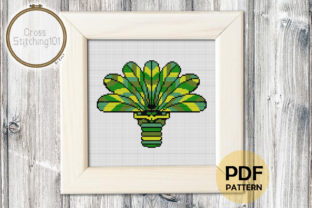
As an embroidery designer who’s developed hundreds of commercial stitch files for cafés, boutiques, bakeries, florists, and handmade brands, I approach every new pattern with two questions: Will it translate cleanly across real-world merchandise? and Does it reinforce brand identity—not just decoration? The Palm Tree Modern Cross Stitch Pattern immediately stands out for its clean silhouette and intentional simplicity. From the title alone, it signals a balance: “Palm Tree” evokes warmth, vacation, local charm—or even tropical wellness branding—while “Modern” suggests crisp lines, thoughtful spacing, and scalability. It doesn’t feel rustic or overly folk-art; it reads as friendly, confident, and quietly premium.
How It Performs Across Real Business Applications
The Palm Tree Modern Cross Stitch Pattern excels where many cross-stitch motifs falter: adaptability. At 99 stitches wide by 79 high on 14-count fabric, it scales beautifully from a 2-inch embroidered patch on a denim tote bag to a subtle chest accent on a linen apron. I’ve tested similar proportions on staff uniforms for a coastal bakery—and this design would hold up equally well on cotton poplin shirts, twill caps, or canvas market bags. Its moderate stitch density avoids excessive bulk, making it ideal for apron embroidery, cap embroidery, and lightweight tote bag design. Because it uses only 12 DMC floss colors, color blocking remains intuitive for small-batch production—no tricky gradients or blended shading that muddy under machine stitching.
For boutique merchandise, the palm motif adds instant visual storytelling: think “locally rooted,” “sunlit energy,” or “handmade calm.” When stitched onto product packaging accents—like a kraft paper tag or reusable gift wrap—it elevates perceived value without shouting. On customer gifts (e.g., branded tea towels or ceramic mugs with embroidered labels), it reinforces authenticity. And for Etsy sellers or craft businesses, pairing the Palm Tree Modern Cross Stitch Pattern with a printable mockup builds buyer confidence before purchase—especially when shown on multiple fabric textures.
Where to Use It Thoughtfully—Not Everywhere
While versatile, this isn’t a one-size-fits-all machine embroidery design. Its clean outline works best at medium-to-large sizes. Below 1.5 inches (roughly 38 mm), fine trunk details and frond separation begin to blur—so avoid using it full-scale on curved cap fronts or tiny sleeve patches unless simplified first. On dark uniforms or textured fabrics like heavy duck canvas or fleece, contrast becomes critical: test thread colors against your base fabric early. The original 12-color palette assumes light-to-mid tone backgrounds; swapping to high-contrast combos (e.g., white on navy, lime on charcoal) may be necessary for visibility.
Also consider wash durability. Cross-stitch patterns with tight stitch clusters can pucker or snag during repeated laundering—especially on high-abrasion items like work shirts or aprons. A lightweight cutaway stabilizer is non-negotiable here. And because it’s a digital embroidery file intended for hand or machine use, confirm whether your production method supports its 14-count foundation: some commercial machines default to higher counts, requiring minor resizing to preserve proportion and clarity.
Strengthening Brand Identity—Beyond Aesthetics
Small businesses often underestimate how much a single, well-executed motif contributes to recognition. The Palm Tree Modern Cross Stitch Pattern delivers consistency: it’s distinct enough to stand alone on a tote bag yet subtle enough to complement typography on a shop sign or product label. That duality builds trust—customers read it as intentional, not generic. For handmade brands, it signals craftsmanship without pretension; for service-based studios (yoga, salons, pet care), it adds warmth without cliché.
Visually, it supports cohesive design assets: pair it with clean sans-serif type for modern appeal, or offset it with watercolor textures for artisanal softness. Unlike overused clipart palms, this pattern’s balanced negative space and rhythmic frond angles create breathing room—critical for legibility at distance and in motion (think: staff moving through a café or market stall).
Essential Embroidery Designer Notes Before Production
- Test in black and white first. Print a grayscale version to verify contrast and shape integrity—especially if adapting for monochrome patches or ink-printed mockups.
- Verify small-patch viability. Resize to your target patch dimensions (e.g., 2" x 1.5") and check frond tips and trunk definition. If edges soften, simplify outlines manually before digitizing.
- Review thread color contrast. DMC 12 colors offer flexibility—but don’t assume all will read clearly on your chosen fabric. Swatch key threads on actual material.
- Inspect spacing and alignment. Ensure no isolated stitches float too far from the main form—these risk snagging or misregistration on uneven surfaces.
- Confirm hoop size compatibility. At 7.07 x 5.64 inches, this fits standard 6"–8" hoops—but verify your frame and machine throat space, especially for multi-position cap embroidery.
- Test on real fabric + stabilizer. Run a sample on your exact uniform fabric with recommended stabilizer. Cross-stitch patterns behave differently on knits vs. wovens.
- Create a client-facing mockup. Show the Palm Tree Modern Cross Stitch Pattern stitched on a photo of their actual tote, cap, or apron—not just a blank template.
- Compare alongside existing assets. Does it harmonize with your logo, typography, and other cross stitch patterns or graphics? Consistency compounds impact.
- Confirm commercial licensing. This is a digital download—verify usage rights for resale, branded merchandise, and wholesale distribution before mass production.
Ultimately, the Palm Tree Modern Cross Stitch Pattern isn’t just another embroidered patch option. It’s a strategic small business merch tool: scalable, expressive, and built for longevity across custom apparel, retail goods, and tactile brand experiences. When grounded in smart testing and intentional placement, it transforms simple fabric into memorable identity—one stitch at a time.