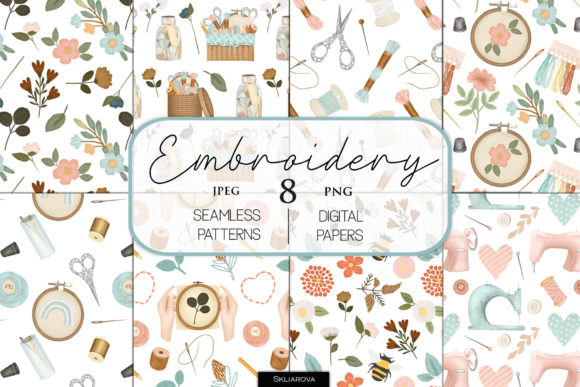
Embroidery Seamless Patterns
First Impression: Modern, Versatile, and Booth-Ready
As an embroidery designer who’s packed up a booth for over twelve craft fairs—and shipped thousands of handmade products to Etsy buyers—I opened Embroidery Seamless Patterns expecting utility, not just prettiness. What stood out immediately was its quiet confidence: no loud trends, no forced whimsy—just clean, repeatable motifs built for real-world production. It reads as modern with a soft hand—neither starkly minimal nor overly ornate. Think elevated farmhouse meets contemporary boutique: subtle texture, balanced negative space, and intentional rhythm. That’s gold at a crowded market where customers glance for under three seconds before moving on.
Where It Shines: From Tote Bags to Tea Towels
Embroidery Seamless Patterns isn’t a “one-product wonder.” Its strength lies in adaptability across your most reliable craft fair sellers:
- Tote bag design: Works beautifully scaled large across the front panel—creates instant visual cohesion without overwhelming the shape.
- Apron embroidery: Perfect for waistband borders or pocket accents; repeats cleanly along curved seams when digitized thoughtfully.
- Tea towel embroidery: Holds clarity even on textured linen or cotton terry—no bleeding, no lost detail, thanks to its open structure and moderate stitch density.
- Embroidered patch: Cuts cleanly as a standalone motif or as part of a curated set—ideal for small shop product bundles or gift-ready pouches.
- Pillow covers & fabric pouches: Scales down gracefully for 6”–8” repeats, giving boutique makers consistent branding across multiple SKUs.
- Market bags & caps: Use cropped sections—not the full repeat—for bold, recognizable focal points that pop in booth lighting.
And yes—it photographs exceptionally well for Etsy listings. The 5000×5000 px resolution means crisp printable mockups, clean zoom-ins, and sharp thumbnails. No pixelation, no muddy edges. That’s non-negotiable for digital embroidery file buyers scrolling on mobile.
Real Production Notes: What You’ll Actually Need to Know
This isn’t just pretty pixels—it’s a working design asset. Here’s how it behaves in the real world:
- Easy to read at a glance: No tiny lettering or micro-details that vanish at 3” scale. Customers see the pattern’s flow instantly—even from six feet away.
- Focal or accent? Both. Full-repeat layouts command attention on aprons or tote fronts; smaller cropped motifs work elegantly as corner flourishes on pillow covers or tea towels.
- Batch-friendly: Because it’s seamless, you’re not wrestling with alignment between panels—fewer re-hooping moments, faster turnaround for craft fair prep.
- Thread colors translate cleanly: RGB at 300 dpi gives accurate color relationships—critical when matching thread palettes for commercial embroidery or coordinating kits.
Careful-Use Notes: Where Attention Prevents Regrets
Even great Embroidery Seamless Patterns need smart execution. Watch for:
- Dense stitch areas: While overall density is moderate, some motifs include tight fill sections—test on your target fabric *before* cutting 50 tea towels.
- Textured towels & thick fabrics: Linen blends and terry absorb more thread—add lightweight cutaway stabilizer to preserve definition.
- Curved cap surfaces: Avoid placing high-detail repeats across crown seams. Opt for simplified segments instead.
- Dark fabric: The RGB files render beautifully—but always test thread contrast. A light motif may need tone-on-tone shading or metallic accent threads for visibility.
- Small sizes: Below 2.5”, fine lines and narrow spacing can blur. Stick to bolder cropped sections for patches under 3”.
Booth Impact & Buyer Psychology
At a craft fair, Embroidery Seamless Patterns quietly elevates perceived value. It doesn’t scream—so it doesn’t fatigue the eye. Instead, it signals intentionality: thoughtful repetition, refined spacing, cohesive rhythm. That tells customers, “This maker pays attention to craft—not just speed.” It strengthens brand consistency across your table (same pattern on aprons, pouches, and tea towels), builds trust through visual harmony, and invites touch—because clean repeats feel tactile, not flat.
It also boosts buyer engagement: shoppers linger longer when they recognize subtle variation within repetition. They’ll point it out to friends (“Look how it flows!”). That’s organic marketing—no signage required.
Designer-to-Designer Must-Dos Before You Stitch
Before turning Embroidery Seamless Patterns into finished product, do this:
- Test the design on scrap fabric—same weight and weave as your final product.
- Check thread contrast against your top three fabric colors (especially darks and heathers).
- Review spacing and overlap if stitching across seams—e.g., apron pockets or pillow flanges.
- Confirm hoop size compatibility—some seamless repeats demand larger hoops for full-motif placement.
- Inspect stitch density in your embroidery software—adjust underlay or reduce fill angles if needed for heavy fabrics.
- Use the right stabilizer: tear-away for stable cottons, cutaway for knits or towels.
- Create at least one real mockup—not just digital—and photograph it in natural light.
- Compare how the pattern reads across fabric types: does it soften too much on slubbed linen? Pop too sharply on satin?
- Verify commercial licensing terms—this is a digital embroidery file, and usage rights affect your ability to sell finished products.
Remember: Embroidery Seamless Patterns is a tool—not magic. Its power multiplies when paired with your judgment, your fabric knowledge, and your understanding of what makes a handmade product feel special in person. Used well, it becomes part of your signature—not just another pattern in your library.